Tsedang: The Cradle of Tibetan Civilization – Unveiling the Yarlung Valley's Ancient Royal Heritage
Imagine a valley so steeped in history that every stone, every ruin, whispers tales of kings, myths, and the very dawn of a civilization. Picture a landscape where the first Tibetan kings built their palaces, where the earliest Buddhist temples rose, and where the origins of Tibetan culture and governance took root. This is Tsedang (Ze^tang), the administrative center of Shannan (Lhoka) Prefecture, nestled within the fertile Yarlung Valley (YarlungGou) in southeastern Tibet. Often overlooked in favor of Lhasa, Tsedang is in fact the birthplace of Tibetan civilization, a region brimming with archaeological sites, ancient monasteries, and the tombs of legendary kings. For those who yearn to trace the earliest threads of Tibetan history, to walk in the footsteps of ancient royalty, and to explore the foundational myths of the plateau, Tsedang offers an unparalleled journey into the very soul of Tibet. It’s a profound exploration of beginnings, an essential pilgrimage for history buffs, and a captivating contrast to the more prominent religious centers.
Tsedang's Profound Significance: Where Tibet Began
Tsedang and the surrounding Yarlung Valley hold an unparalleled place in the narrative of Tibet, often referred to as the "Cradle of Tibetan Civilization."
The Yarlung Valley: Home of the First Kings
The Yarlung Valley is where the Yarlung Dynasty (YarlungWangchao) emerged, giving rise to the first Tibetan kings and ultimately, the Tibetan Empire.
-
Mythical Origins: According to legend, the first Tibetan king, Nyatri Tsenpo, descended from the sky to a mountain in the Yarlung Valley, marking the beginning of the royal lineage.
-
Ancient Capital: For centuries, the Yarlung Valley served as the political and cultural heartland before Lhasa rose to prominence. The early Tibetan kings established their palaces, fortresses, and burial grounds here.
-
Agricultural Heartland: Its relatively fertile lands, fed by the Yarlung Tsangpo River (the upper Brahmaputra), allowed for early agricultural development, sustaining the nascent civilization.
Cradle of Tibetan Culture and Governance
The Yarlung Valley, with Tsedang at its heart, saw the initial development of many aspects of what we now recognize as Tibetan culture:
-
Early Political Structures: The foundational elements of Tibetan governance and social organization were established by the Yarlung kings.
-
Ancient Buddhism: While Buddhism gained widespread prominence later with King Songtsen Gampo in Lhasa, its very first seeds in Tibet were sown in the Yarlung Valley.
-
Language and Script: The development of the Tibetan script, crucial for translating Buddhist scriptures and recording history, is intrinsically linked to the cultural flowering under the early kings.
Tsedang thus represents the bedrock upon which the entire edifice of Tibetan civilization was built, preceding even the grandeur of Lhasa by centuries.
Geographical Context: A Strategic and Fertile Basin
Tsedang is situated at an elevation of approximately 3,550 meters (11,647 feet), making it slightly lower in altitude than Lhasa (3,650m).
-
Relative Accessibility: This lower altitude makes it a comfortable acclimatization stop for those arriving from Lhasa or exploring the region.
-
Yarlung Tsangpo Proximity: The town is close to the mighty Yarlung Tsangpo River, which flows through the valley, providing water for agriculture and acting as a natural artery for the region.
-
Strategic Location: Historically, its location within a fertile and defensible valley made it an ideal base for early kingdoms.
The Tsedang Experience: Unearthing Ancient Legends and Sacred Sites
Visiting Tsedang is a journey through time, offering unique insights into the foundational myths, early architecture, and ancient history of Tibet that are found nowhere else.
1. Yumbulakang Palace: Tibet's Oldest Building
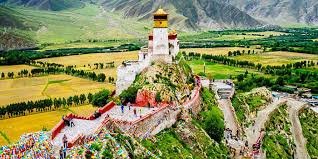
Yumbulakang Palace (YumbuLagang) is arguably the most historically significant site in the Yarlung Valley.
-
Legendary Origins: Reputed to be the first palace in Tibet, built for the first Tibetan king, Nyatri Tsenpo, in the 2nd century BC. While the current structure is a reconstruction (the original was destroyed during the Cultural Revolution), its historical significance remains profound.
-
Fortress-like Architecture: Perched dramatically on a rocky outcrop, the palace resembles a watchtower or a miniature fortress. Its imposing position offers panoramic views of the Yarlung Valley.
-
Mythological Significance: It's considered the dwelling place of the earliest Tibetan kings and is deeply intertwined with the legends of Tibet's origins. Inside, you'll find shrines dedicated to the early kings.
2. Trandruk Monastery: Ancient Buddhist Beginnings
Trandruk Monastery (ChangzhugSi) is one of the oldest Buddhist monasteries in Tibet, believed to have been founded by King Songtsen Gampo in the 7th century, at the same time as Jokhang Temple in Lhasa.
-
Ancient Foundation: It's considered one of the earliest Buddhist sites in Tibet, part of a set of geomantic temples built by King Songtsen Gampo to subdue a demoness lying across the land.
-
Precious Pearl Thangka: The monastery is famous for a unique thangka (religious scroll painting) crafted from 29,000 pearls, depicting Avalokiteshvara.
-
Architectural Evolution: The monastery has undergone numerous expansions and renovations over centuries, showcasing a blend of architectural styles from different periods. Its serene setting offers a glimpse into early Buddhist practices.
3. Samye Monastery: Tibet's First Monastery
Located across the Yarlung Tsangpo River from Tsedang (requiring a ferry or drive), Samye Monastery (SamyeSi) holds unparalleled significance as the first monastery in Tibet to be formally established with monks and a complete monastic complex.
-
Built in the 8th Century: Founded by King Trisong Detsen in the 8th century, with the guidance of Padmasambhava (Guru Rinpoche) and Shantarakshita.
-
Mandala Design: Its unique layout is a giant three-dimensional mandala, representing the Buddhist cosmos, with a central hall and temples representing continents and oceans.
-
First Ordinations: The first seven Tibetan monks were ordained here, marking the true beginning of Tibetan monastic Buddhism.
-
Translation Hub: Samye was also a crucial center for the translation of Buddhist scriptures from Sanskrit into Tibetan.
-
Access: Reaching Samye often involves crossing the Yarlung Tsangpo by local ferry or a longer drive, adding an adventurous element to the visit.
4. Tombs of the Tibetan Kings: Resting Place of Legends
South of Tsedang lies the Tombs of the Tibetan Kings (ZangwangMu), the burial grounds of many powerful Yarlung Dynasty kings.
-
Ancient Burial Mounds: These large, flat-topped burial mounds dot the landscape, some reaching significant sizes. They contain the remains of kings like Songtsen Gampo, Trisong Detsen, and Ralpacan.
-
Historical Significance: While typically unexcavated and less visually dramatic than, say, Egyptian pyramids, their historical and archaeological significance is immense. They represent the final resting places of those who forged the Tibetan Empire.
-
Atmospheric Site: The desolate, windswept setting of the tombs evokes a powerful sense of ancient history and the long lineage of Tibetan royalty.
5. Nedong Town: The Former Capital
Nedong Town (NaidongZhen), adjacent to Tsedang, was historically the site of the former administrative center for the region. While now largely integrated with modern Tsedang, its older sections and the ruins of palaces like the Tagtse Palace offer further insights into the region's royal past.
Tsedang's Role in a Comprehensive Tibet Tour: History Unveiled
While many first-time visitors focus solely on Lhasa, incorporating Tsedang into a Tibet itinerary provides crucial historical depth and a unique perspective on the plateau's rich heritage.
A Natural Progression from Lhasa: Exploring the Roots
Tsedang is easily accessible from Lhasa, making it a natural extension for those who have explored the capital's more recent history.
-
Proximity: It's approximately 180-200 km southeast of Lhasa, typically a 3-4 hour drive.
-
Gentle Acclimatization: At 3,550m, Tsedang offers a slightly lower altitude than Lhasa, providing a good opportunity for further acclimatization or a comfortable start if flying into Lhasa.
Contrast and Context: Beyond Monasteries and Palaces
Tsedang offers a distinct experience compared to the monasteries and palaces of Lhasa and Shigatse.
-
Focus on Origins: It delves into the very origins of Tibetan civilization, not just its later developments.
-
Archaeological Emphasis: The sites here are more archaeological and mythological, fostering a deeper appreciation for the ancient roots of Tibetan culture.
-
Rural Charm: The Yarlung Valley provides a more rural and agricultural backdrop compared to the bustling cities, offering glimpses into traditional farming life.
Essential for History Enthusiasts and Scholars
For travelers with a keen interest in history, archaeology, or the early development of civilizations, Tsedang is an absolute must-visit. It transforms abstract historical narratives into tangible experiences.
Life in Tsedang: Modern Comforts with Ancient Echoes
Tsedang, as a regional administrative center, offers a blend of modern amenities and traditional Tibetan life, set against a backdrop of unparalleled historical significance.
Accommodation and Food: Comfort in the Valley
Compared to remote areas like those around Kailash, Tsedang offers relatively good tourist infrastructure.
-
Hotels and Guesthouses: You'll find a range of hotels, from comfortable tourist-class options to more basic guesthouses.
-
Diverse Cuisine: Restaurants offer a mix of Tibetan, Sichuan, and sometimes Nepalese or Western dishes. Tibetan staples like momos, thukpa, and yak butter tea are readily available.
-
Local Markets: The town has local markets where you can find fresh produce and experience daily Tibetan life.
Cultural Ambiance: Blending Old and New
Tsedang is a working Tibetan town, bustling with local life.
-
Monastic Presence: While less dominated by monks than Lhasa or Shigatse, the presence of monastic life is still evident.
-
Modern Development: As a growing town, Tsedang also shows signs of modern development, with new buildings and infrastructure.
-
Festivals: Like other Tibetan towns, Tsedang observes various traditional Tibetan festivals throughout the year, offering opportunities to witness local celebrations (though these might not always coincide with tourist visits).
High-Altitude Considerations: Managing the Elevation
While slightly lower than Lhasa, Tsedang is still at a significant altitude of 3,550 meters (11,647 feet).
-
Continued Acclimatization: Even if arriving from Lhasa, continue to practice good acclimatization habits: drink plenty of water, avoid strenuous activity on arrival, and be mindful of AMS symptoms.
-
Hydration and Rest: Prioritize hydration and adequate rest to ensure you enjoy your exploration of the ancient sites. Your guide will provide essential advice and monitor your well-being.
Planning Your Tsedang Journey with Golden Trail Travel
A journey to Tsedang and the Yarlung Valley is an expedition into the very origins of Tibet. Due to the permit requirements for foreigners in Tibet and the nuances of visiting historical sites in a remote region, an organized tour with a licensed and experienced operator like Golden Trail Travel is absolutely essential.
Why Choose Golden Trail Travel for Your Tsedang & Tibet Adventure?
-
Unmatched Permit Expertise: Golden Trail Travel specializes in navigating the complex and ever-changing permit system for Tibet. They expertly handle the Tibet Travel Permit (TTP) and any additional permits required for specific regions like the Shannan Prefecture (where Tsedang is located), ensuring a smooth and worry-free entry and travel.
-
Deep Historical & Cultural Knowledge: Golden Trail Travel crafts itineraries that prioritize deep historical and cultural understanding. They recognize Tsedang's unique significance as the "Cradle of Tibetan Civilization" and ensure your visit is guided by knowledgeable local experts who bring its ancient myths, royal lineages, and early Buddhist history to life.
-
Seamless Logistics & Comfort: From securing flights/trains to Tibet, providing comfortable and reliable private vehicles for touring the Yarlung Valley's dispersed sites, and arranging the best available hotel accommodations in Tsedang, Golden Trail Travel manages every detail. This allows you to focus entirely on the immersive historical experience without logistical concerns.
-
Expert Local Tibetan Guides: Your journey will be led by licensed, English-speaking Tibetan guides who possess profound insights into the history, religion, and daily life of Tsedang and the Yarlung Valley. Their local knowledge enriches your exploration of ancient ruins, provides context for the royal tombs, and facilitates respectful interactions.
-
Prioritizing Health & Acclimatization: Golden Trail Travel meticulously plans itineraries to ensure proper acclimatization, especially given Tsedang's altitude. Guides are well-versed in managing AMS symptoms and ensuring your well-being throughout your high-altitude journey.
-
Dedicated 24/7 Support & Peace of Mind: With an unwavering commitment to traveler safety and round-the-clock support, Golden Trail Travel provides complete peace of mind throughout your journey to Tibet's ancient heartland.
Mandatory Requirements for Foreigners Visiting Tibet & Tsedang:
It is crucial to understand that independent travel to Tibet is strictly forbidden for foreigners. You must:
-
Obtain a Tibet Travel Permit (TTP).
-
Travel with a licensed tour guide throughout your journey.
-
Travel in a private vehicle arranged by a licensed tour agency for all routes outside Lhasa.
-
Have a pre-arranged and approved itinerary.
Golden Trail Travel expertly manages all these complex requirements, transforming your dream of exploring Tsedang and the wonders of Tibet into a seamless and safe reality.
Suggested Itineraries with Golden Trail Travel Featuring Tsedang:
Option 1: Central Tibet & Yarlung Valley Historical Journey (8-10 Days) This itinerary is ideal for history enthusiasts, combining the major cultural sites of Lhasa with a deep dive into Tibet's ancient origins in the Yarlung Valley.
-
Day 1-3: Lhasa Acclimatization & Exploration.
-
Day 4: Lhasa to Tsedang – Journey into History.
-
Drive from Lhasa to Tsedang (approx. 3-4 hours), enjoying the scenic Yarlung Tsangpo River.
-
Check into your hotel in Tsedang. Begin light exploration or rest for acclimatization.
-
Day 5: Yarlung Valley Exploration – Yumbulakang, Trandruk & Royal Tombs.
-
Morning: Visit Yumbulakang Palace, Tibet's first palace, perched on a hill.
-
Afternoon: Explore Trandruk Monastery, one of Tibet's oldest Buddhist sites.
-
Later: Visit the ancient Tombs of the Tibetan Kings, the burial grounds of legendary Yarlung Dynasty rulers.
-
Overnight in Tsedang.
-
Day 6: Samye Monastery – Tibet's First Monastery.
-
Morning: Drive to the Yarlung Tsangpo River bank. Cross by ferry (or longer drive via bridge) to visit Samye Monastery, the first formal monastery in Tibet with its unique mandala layout.
-
Afternoon: Return to Tsedang or drive back to Lhasa.
-
Day 7/8: Return to Lhasa & Departure.
-
If staying in Tsedang, drive back to Lhasa.
-
Transfer to Lhasa Gonggar Airport (LXA) for your onward flight.
Option 2: Comprehensive Tibet Exploration with Yarlung Valley (10-14 Days) This itinerary offers a broader exploration of Central Tibet, including Everest Base Camp, with the added historical depth of Tsedang.
-
Days 1-3: Lhasa Acclimatization & Exploration.
-
Day 4: Lhasa to Tsedang & Yarlung Valley Exploration.
-
Similar to Day 4-5 of Option 1, visiting Yumbulakang, Trandruk, and Royal Tombs. Overnight in Tsedang.
-
Day 5: Tsedang to Shigatse (via Samye or direct).
-
Option to visit Samye Monastery in the morning then proceed to Shigatse.
-
Or direct drive from Tsedang to Shigatse (approx. 5-6 hours total from Samye).
-
Explore Tashilhunpo Monastery in Shigatse. Overnight.
-
Day 6-7: Shigatse to Rongbuk Monastery / Everest Base Camp (EBC).
-
Drive to EBC, enjoying stunning Himalayan views. Overnight at Rongbuk Monastery guesthouse.
-
Witness Mount Everest at sunrise/sunset.
-
Day 8-10: Return to Lhasa & Departure.
Ready to explore the ancient origins of Tibetan civilization in Tsedang and the Yarlung Valley? Visit Golden Trail Travel's website to explore their curated Tibet tours and easily book your adventure: https://goldentrailtravel.com/
The Enduring Allure of Tsedang: Echoes of a Golden Age
Tsedang is a journey into the soul of Tibet's past, a place where legends and history intertwine to tell the story of a civilization's birth. It's an essential pilgrimage for anyone seeking to understand the foundational myths, the rise of the first kings, and the very beginnings of Tibetan culture and governance.
The ancient sites of Yumbulakang Palace, standing sentinel over the valley, the venerable Trandruk Monastery, whispering tales of early Buddhism, and the majestic Samye Monastery, a living mandala, offer unparalleled insights into a golden age. Even the silent burial mounds of the Tibetan kings evoke a powerful sense of the lineage and legacy that shaped this unique land.
By venturing to Tsedang, you not only step back in time but also gain a profound appreciation for the depth and richness of Tibetan history that extends far beyond the more commonly visited sites. It’s a journey that connects you to the very roots of a resilient and ancient civilization, making it an unforgettable chapter in any Tibet adventure.
Frequently Asked Questions (FAQ) about Tsedang
Q1: Where is Tsedang located in Tibet? A1: Tsedang (Zêtang) is located in the Shannan (Lhoka) Prefecture, in the southeastern part of the Tibet Autonomous Region. It's situated within the historically significant Yarlung Valley.
Q2: What is the altitude of Tsedang? A2: Tsedang is at an altitude of approximately 3,550 meters (11,647 feet) above sea level. This is slightly lower than Lhasa, making it a comfortable location for acclimatization.
Q3: Why is Tsedang known as the "Cradle of Tibetan Civilization"? A3: Tsedang and the Yarlung Valley are considered the "Cradle of Tibetan Civilization" because this is where the Yarlung Dynasty emerged, giving rise to Tibet's first kings, and where the earliest palaces, fortresses, and Buddhist temples were built, marking the foundational period of Tibetan culture and governance.
Q4: What are the most important historical sites to visit in Tsedang and the Yarlung Valley? A4: The most important sites include Yumbulakang Palace (Tibet's first palace), Trandruk Monastery (one of Tibet's oldest Buddhist monasteries), Samye Monastery (Tibet's first formal monastery, located across the Yarlung Tsangpo River), and the Tombs of the Tibetan Kings.
Q5: What is unique about Samye Monastery? A5: Samye Monastery is unique because it was the first monastery in Tibet to be formally established with monks, and its layout is designed as a giant, three-dimensional mandala representing the Buddhist cosmos. It was also a crucial center for the translation of Buddhist scriptures.
Q6: How far is Tsedang from Lhasa, and how do I get there? A6: Tsedang is approximately 180-200 kilometers (112-124 miles) southeast of Lhasa. It's typically a 3-4 hour drive. Foreigners must travel by private vehicle as part of an organized tour with a licensed guide.
Q7: Is it safe to travel to Tsedang due to the altitude? A7: Yes, it is generally safe, especially with proper acclimatization. Tsedang's altitude is slightly lower than Lhasa, which can aid in further acclimatization. It's crucial to follow your tour guide's advice regarding hydration and rest to prevent Acute Mountain Sickness (AMS).
Q8: What kind of accommodation and food can I expect in Tsedang? A8: Tsedang, as a regional center, offers relatively comfortable hotels and guesthouses. Food options are varied, including Tibetan, Sichuan, and some Western dishes. You can expect hearty meals suitable for the high-altitude climate.
Q9: What is the significance of the Yarlung Tsangpo River in this region? A9: The Yarlung Tsangpo River (the upper Brahmaputra) flows through the Yarlung Valley, providing a crucial water source for agriculture that supported the early Tibetan civilization. It's also the river that must be crossed to reach Samye Monastery.
Q10: Can I visit Tsedang as part of a general Tibet tour? A10: Yes, many comprehensive Tibet tours, particularly those focused on history and culture, include Tsedang as an extension from Lhasa. It provides an excellent historical context for understanding the rest of Tibet.
Customer Reviews for Tsedang and Golden Trail Travel
"Visiting Tsedang was an absolute revelation! Walking through Yumbulakang and knowing I was at Tibet's first palace was incredibly powerful. Golden Trail Travel organized a fantastic historical itinerary, and our guide was a true scholar, bringing every ancient ruin to life. A must for history buffs!" — Dr. Alistair Finch, UK
"Samye Monastery, reached by a thrilling ferry ride, was unlike anything I'd seen in Tibet – a true mandala. The Yarlung Valley journey with Golden Trail Travel gave us such a deep understanding of Tibetan origins. Their planning and expert guides make historical travel so enriching and hassle-free." — Professor Lena Kuznetsov, Russia
"Tsedang truly is the 'Cradle of Civilization.' Exploring Trandruk and the Royal Tombs felt like uncovering ancient secrets. Golden Trail Travel curated a perfect trip, balancing historical depth with comfortable travel. Their attention to detail, especially regarding our acclimatization, was much appreciated." — The Miller Family, USA
"Golden Trail Travel brought the ancient history of Tsedang to life for us. Our guide's narratives about the early kings and the birth of Buddhism were captivating. It was a beautiful contrast to the bustling streets of Lhasa, offering a quiet, profound journey into Tibet's roots." — Wang Li & Family, Singapore
"For anyone serious about Tibetan history, Tsedang is non-negotiable. The sites are incredibly significant, and Golden Trail Travel's expert guidance ensured we understood every layer of their importance. From permits to perfect logistics, they made this unique historical expedition possible." — Marc Dubois, Canada